How a Music Festival Becomes One Big Network
Loxation Team
- 11 minutes read - 2341 wordsHow a Music Festival Becomes One Big Network
BLE mesh, WiFi backbone, and a router that runs on a phone.
It’s the headliner. 80,000 people are in one field. Half of them just pulled out a phone to take the same photo. The cell network — designed for everyday density, not festival density — has fallen over for hours. Bars are gone. Texts are queued up to be sent next Tuesday. Calls fail on connect. Your group, the people you came with, are somewhere in this crowd, and you have no way to reach them.
This isn’t a malfunction. It’s the predictable outcome of putting a stadium’s worth of phones inside a square mile and asking the carrier to handle it. Cell towers don’t break at festivals; they max out exactly as designed and graceful-degrade into uselessness.
The fix is not another tower. The fix is a network the festival itself owns, that goes up with the rigging, comes down with the tear-down, and never asks the carriers for permission. This post is about how we built that network — and how it actually works on the night.
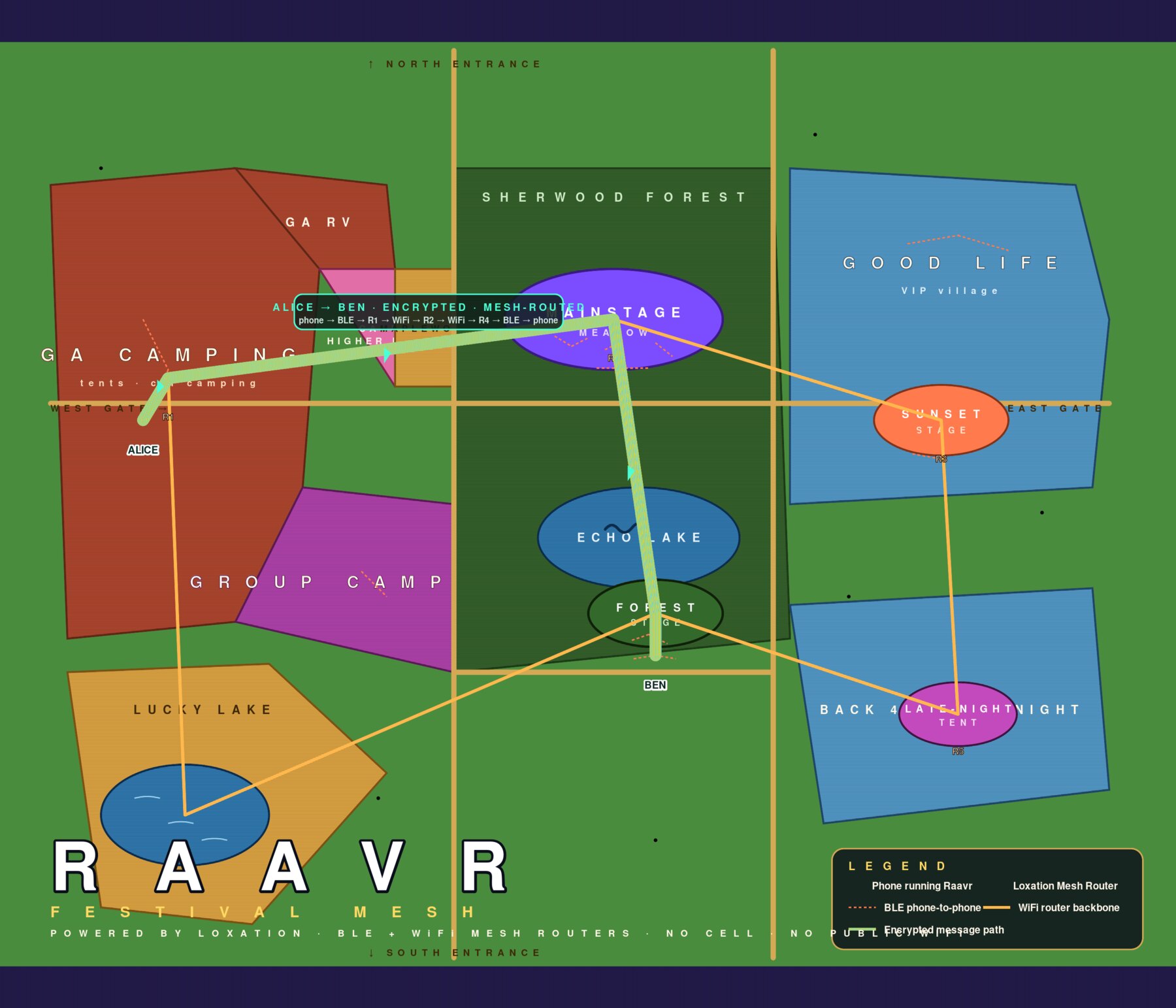
Three layers, one network
The system has three layers. Each one was already mostly possible before; the trick is binding them together so they behave as a single network from an attendee’s perspective.
Layer 1: phones running PLURNet. Every modern phone has a Bluetooth Low Energy radio that reaches roughly 30 meters in open air. When a phone is running PLURNet, it broadcasts and listens for other PLURNet phones in BLE range. The phones that hear each other form a pocket — a local mesh. In a tight crowd at the stage rail, you’ve got hundreds of phones in BLE earshot of each other. Messages, presence signals, and group chats hop phone-to-phone through that pocket without ever leaving the radio waves around the crowd.
Layer 2: BLE multi-hop routing. Inside a pocket, phones don’t just talk to neighbors — they relay for each other. A message from someone at the front of the stage to someone at the back of the same crowd hops phone → phone → phone until it gets there. We use TTL counters and deduplication to keep the routing well-behaved (no infinite loops, no broadcast storms), and a fragmentation/reassembly layer so messages bigger than a single BLE advertisement can travel intact. The protocol is documented at length in our Blemesh spec; the short version is that phones in a pocket act as a self-healing mini-internet.
Layer 3: Loxation Mesh Routers. Pockets aren’t enough at festival scale. A festival is hundreds of acres. The crowd at Stage A and the crowd at Stage C are way out of BLE range of each other. Even the people walking between them — the connective tissue — aren’t continuous enough to form a reliable bridge. Without infrastructure, the network fragments into islands. So we put infrastructure on the field: hardened router devices, mounted on light poles and trusses and ops tents, that link to each other over a private WiFi backbone and speak BLE to nearby phones. Each router is a bridge — pulling encrypted packets out of one BLE pocket, carrying them across the WiFi backbone to another router on the other side of the venue, and dropping them into the destination pocket.
Phones never associate with the routers as wifi clients. They keep talking BLE the whole time. The routers are infrastructure, not access points. Attendees don’t see them, don’t connect to them, and don’t need to know they exist.
Walking through one message
Imagine Alice is in GA Camping at the west edge of the festival. Ben, her friend, is at the Forest Stage on the east side, three quarters of a mile away. She wants to ask him whether to bring water bottles when she walks over. There’s no cell. The cell-tower-on-wheels the carrier rolled in is saturated. Public wifi is a cruel joke.
She types the message in PLURNet and hits send. Here’s what happens, in something like 200 milliseconds:
-
Encryption on Alice’s phone. The message is wrapped in MLS (the same end-to-end encryption Signal’s protocol family uses for groups) and turned into ciphertext. Nothing else in the chain — not the next phone over, not the routers, not Loxation’s servers if they’re even reachable — can decrypt it.
-
BLE hop in the GA Camping pocket. Alice’s phone broadcasts the encrypted packet over BLE. A nearby phone — someone two tents over — picks it up, sees that the destination isn’t them, and relays it. After a couple of hops, the packet reaches a phone in BLE range of R1, the closest Loxation Mesh Router (mounted on a pole at the edge of the camping zone).
-
R1 picks it up. R1 hears the packet, sees the destination address, and looks at its routing table. The destination phone (Ben’s) was last announced from the Forest Stage pocket — which means R1 should hand the packet to R4, the router covering the Forest Stage area.
-
WiFi backbone hop. R1 sends the encrypted packet to R4 over the routers’ private WiFi mesh. The hop crosses the entire venue in tens of milliseconds. R1 still cannot decrypt the packet — it’s just carrying ciphertext.
-
R4 broadcasts into the Forest Stage pocket. R4 hears that Ben’s phone is nearby (Ben’s phone has been periodically announcing presence into the BLE pocket around it). R4 broadcasts the packet over BLE.
-
BLE hop to Ben. A phone near Ben relays it. Ben’s phone receives it, decrypts with his MLS keys, and shows the message: “u want me to bring water?”
The packet has traveled across hundreds of acres, used four different radios at three different layers, never touched the public internet, and was end-to-end encrypted the entire way. The festival owns the network it traversed. The carriers have no idea any of this happened.
“Even Loxation can’t read it”
The encryption layer is non-negotiable and worth dwelling on for a second, because it’s where festivals (and venues, and event producers, and a privacy-aware audience) get nervous.
Group messages on PLURNet use MLS — Messaging Layer Security, the IETF standard that’s the protocol successor to Signal’s Double Ratchet for group chat. One-to-one DMs use Noise (specifically the X25519-HKDF-AESGCM handshake pattern). Both are end-to-end: keys live on the sending and receiving devices, never on the routers, never on Loxation’s servers.
A Loxation Mesh Router, in transit, sees one thing: a sealed envelope of ciphertext addressed to a peer. It cannot decrypt it. It cannot inspect message contents. It cannot identify who sent it (peer IDs rotate). It can route it, count it for telemetry, and pass it along. That’s it.
This isn’t a privacy policy. It’s the cryptography. We can’t read messages even if subpoenaed, even if compromised, even if we wanted to — the routers literally do not have the keys.
Why not just use cell? Or public WiFi? Or X?
The space of “off-grid comms” has been crowded with ideas for years. A few that don’t work for festival scale, and why:
Cell with COWs (cells on wheels). Carriers absolutely roll cells on wheels in for big events. They help. They do not solve density at festival scale. The arithmetic is brutal: a cell sector handles a few hundred to low thousands of concurrent active users; festivals have tens of thousands of phones in a single sector’s footprint. Adding a COW raises the ceiling but doesn’t change the structural problem.
Public wifi at the venue. Same density issue, plus a captive portal that needs a cell connection to authenticate, plus a single backbone that gets DDoS’d by Instagram uploads. We’ve all sat in airports with “free wifi” that doesn’t actually pass packets.
Walkie-talkies / DMR radios. Great for ops teams (10-20 people on a private channel). Doesn’t scale to attendees. Half-duplex voice, no text, no group chat semantics, regulatory limits on simultaneous channels.
Ad-hoc Bluetooth apps (Bridgefy, Bitchat, etc.). Phone-to-phone BLE works in dense crowds at small to medium scale and we use the same trick at Layer 1. But without infrastructure, it fragments at large scale. The crowd at Main Stage and the crowd at Forest Stage become disconnected islands. That’s exactly what the Loxation Mesh Routers exist to fix.
Starlink / LEO satellite. Solves backhaul for the festival’s own infrastructure (great), but doesn’t solve the last-meter problem of getting bytes to and from 80,000 phones in dense terrain. Still hits the density wall on the wifi/cell side.
The answer, the way every robust networking story ends up, is layered: short-range radios at the device tier, infrastructure backbone in the middle, optional internet uplink only when present. That’s exactly what the PLURNet + Loxation Mesh Router architecture is.
What the hardware actually is
The Loxation Mesh Router is — and this is where engineers either nod or wince — a hardened build on a specific Android device. Off-the-shelf mobile silicon. Custom firmware. We picked Android because the SoC has all the radios we need (BLE 5, dual-band WiFi, optional 4G/5G if we want it), the power management is mature, the supply chain is deep enough to source thousands of units without inventing hardware, and the failure modes are well-understood. The “router” is a phone that decided to be infrastructure.
Specs that matter:
- Battery: 4,500–5,000 mAh internal cell.
- Runtime: 8–10 hours on a single charge under typical festival load.
- Power: USB-C. Plug into house power for continuous operation, or run on battery for 8–10 hours, or hot-swap units on a rotation for multi-day events.
- Mounting: trusses, light poles, ops tents. Festival production crews mount rigging for a living; Loxation routers go up the same way.
- Auto-config. Routers find each other on power-up and form the WiFi mesh without manual setup.
- Ciphertext-only. As above: routers carry encrypted bytes, never decrypt.
The 8–10 hour runtime is sized intentionally. A typical festival day runs 12–14 hours from gates to last set. A unit on house power is up the whole time. A unit on battery covers a full main-day shift, then swaps with a charged unit during a quiet hour. For multi-day festivals, the swap rotation is part of the run-of-show, the same way generator fuel runs and lighting truss inspections are part of the run-of-show.
What this enables
Once you have a network the festival owns, separated from the carriers, with end-to-end encryption built in, the things you can layer on top are interesting:
Find-your-crew. Attendees see roughly where their friends are on the site without GPS, without a working cell tower, without uploading a precise location to anyone. The “lost friend” stress that defines multi-day festivals largely goes away.
Festival-wide announcements. Set time changes, weather alerts, last-call shuttle notices, lost-and-found, missing-person broadcasts. All pushed to every phone on the mesh. Independent of carriers, so they don’t fail at peak.
Ops and medical channels. Production, medical, security, and stage-management teams get private broadcast channels separate from the public ones. Coordinated comms during a weather hold. Real-time medical-tent dispatch. None of it on public radio frequencies, none of it on the carrier network that’s already fallen over.
Crowd density visibility. Anonymized presence telemetry — “approximately N phones on the mesh in this zone right now” — gives ops teams real-time situational awareness without identifying individuals. Useful for safety, useful for logistics, completely separate from any consumer-tracking practice.
The next thing. Once a venue owns this layer, all kinds of integrations become possible. Wristband activation. Cashless payments routed locally. Setlist push notifications. AR overlays for the venue map. We deliberately did not bundle any of this in version one — PLURNet is the comms layer, not the festival app — but the platform is there, the encryption model is there, and the routing capacity is there.
What we’re not
A few things this is not, in case you’re tempted to read the architecture as broader than it is:
Not a replacement for ticketing. Eventbrite and Ticketmaster keep doing what they do. Loxation runs alongside.
Not a replacement for payments. Apple Pay, Stripe, Square, Venmo all keep working when there’s any internet at all, and PLURNet doesn’t try to be a wallet.
Not a social network. No feed. No engagement metrics. No advertising. PLURNet is for finding your crew at the festival you’re already at, then leaving.
Not a tracking platform. Bluetooth identifiers rotate constantly. Phone numbers are not collected. When you leave the venue, you leave the mesh. Nothing follows you home.
Where this goes
We’re booking deployments now for the 2026 summer festival season. The Mesh Router hardware is available for purchase outright (festivals and event production companies that run multiple events per year) or for per-event rental (one-off festivals, single-night raves, single-event productions). Either way, Loxation handles deployment design, on-site engineering for the run of show, and tear-down. Your production team mounts the routers; we run the network.
The bigger story, from where we sit, is that the comms layer at any large gathering — a festival, a marathon, a championship game, a convention, a disaster-response staging area — has been a problem for the carriers to solve, and the carriers have not solved it. The architecture in this post is a different bet: that the venue itself should own the comms layer, that it should be infrastructure rather than service, and that end-to-end encryption is the right default rather than an upgrade. The festival is the dramatic case. The architecture generalizes.
If you run a festival, a venue, or a large-scale event and any of this resonates, we’d love to talk. Book a deployment or learn more on the festivals page.
If you’re an attendee, PLURNet is on iOS and Android, free. Open it at the gate. You’re on the mesh.
Loxation builds infrastructure for large-crowd communications. The PLURNet app is our consumer-facing reference deployment, free on iOS and Android. The Loxation Mesh Router is purpose-built BLE-mesh-extension hardware, deployed by festival and venue operations teams. End-to-end encryption is non-negotiable across both. We can’t read your messages even if we wanted to.
Find your crew. No bars needed.